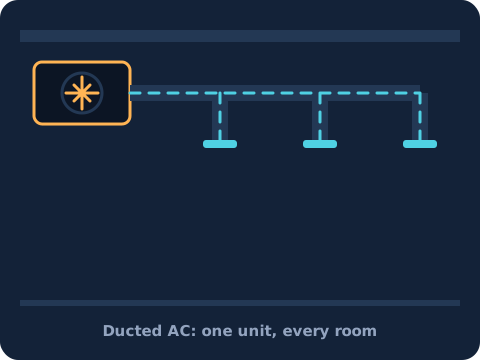
Why is your ductable AC not cooling properly? A ductable (ducted) AC cools several rooms from one concealed unit through ceiling ducts, so cooling problems usually come from airflow, refrigerant or the blower, not a dead compressor. This guide covers the causes, the checks you can do yourself, and when to call a technician.
In this guide
- Common causes of a ductable AC not cooling
- Airflow problems: causes and fixes
- How to improve cooling
- Gas leakage: causes and repair
- Compressor problems and solutions
- Noise: common causes
- Water leakage: causes and solutions
- Signs it needs professional repair
Common causes
- Clogged air filters or blocked return grilles
- Leaking, disconnected, or crushed ducts
- Closed or faulty zone dampers
- A frozen evaporator coil from poor airflow
- Low refrigerant after a slow leak
- A weak blower motor or failing capacitor
What you can check yourself
- Replace or clean the filters, and make sure furniture is not covering a return grille.
- Hold a hand to each vent and note which rooms have weak or warm air.
- If you see ice on the refrigerant pipes, run fan-only mode for an hour to thaw it.
- Check the thermostat batteries and test it with a lower set temperature.
Ductable AC Airflow Problems: Causes and Fixes
Weak airflow is the most common ductable AC complaint, and it is rarely the compressor. Check these in order:
- Dirty filters or blocked return grilles starve the blower of air
- Crushed, kinked or disconnected duct sections leak cooled air above the ceiling before it reaches the room
- Dampers left closed or stuck cut off a room or zone
- A dirty blower wheel, or a weak blower motor or capacitor, moves less air than it should
- A dirty evaporator coil restricts airflow and can freeze
Hold a hand to each vent. One weak vent points to that duct branch or damper; every vent weak points to the filter, blower or coil. Filter, coil and accessible duct cleaning can be done on the same visit as the repair — see AC deep cleaning.
How to Improve Cooling in a Ductable AC System
- Clean or replace filters regularly, and every few weeks in heavy use
- Keep return grilles and supply vents clear of furniture, curtains and rugs
- Have leaking ducts sealed and ducts in hot ceiling spaces insulated, so cooled air isn’t lost on the way
- Ask a technician to balance the dampers so far rooms get their share of air
- Keep the outdoor unit’s coil clean and its surroundings clear
- Close doors to cooled rooms and cut direct afternoon sun with blinds or curtains
- Book a service before summer rather than after the first heatwave (see the pre-summer AC checklist)
If cooling is still poor with clean filters and open vents, low refrigerant or a blower fault is the likely cause. Book a ducted AC repair check.
Ductable AC Gas Leakage: Causes and Repair
A ductable AC doesn’t consume gas. If the refrigerant is low, there is a leak. Common leak points are flare and brazed joints, service valves, copper pipes stressed by vibration, and pinholes in the coils.
Signs include warm air with the blower running, ice on the coil or refrigerant pipes, a hissing sound, oily residue at joints, long compressor run times and rising bills. The repair is to pressure test the system, find and seal the leak (brazing, or replacing the damaged section), vacuum, then recharge to the specified level. Topping up without fixing the leak only lasts a few weeks. More detail: how to detect an AC gas leak and which gas your AC uses.
Ductable AC Compressor Problems and Solutions
A compressor that won’t start or won’t pump is often blamed when a smaller part has failed, so the right order is to test the simple parts first.
- Signs: the outdoor unit hums but doesn’t start, the blower runs but the air is warm, the breaker trips, there is grinding or loud clanking, or the unit cuts out on overload
- Common causes: a failed start or run capacitor or contactor, low refrigerant, a dirty outdoor coil causing overheating, voltage fluctuation, or worn windings
- Solutions: test the capacitor, contactor and electrical supply first; clean the outdoor coil; repair any leak; replace the compressor only when testing shows it has failed
Avoid repeatedly restarting a unit that hums or trips, because that can burn out the compressor. Voltage swings are a frequent trigger — see voltage stabilizers for AC. On an older system, our repair vs replacement guide helps you decide whether a major repair is worth it.
Ductable AC Making Noise? Common Causes Explained
- Rattling or vibration — loose duct panels, hangers or blower housing screws
- Humming or buzzing — a weak capacitor, the blower motor or the contactor
- Squealing — worn blower bearings or belt
- Whistling — restricted airflow from a dirty filter, or a vent or grille that is too small
- Popping or booming — ducts expanding and contracting as they warm and cool, usually harmless
- Gurgling — air in the refrigerant line, or water trapped in the drain
Loud grinding, or a buzz together with weak cooling, means switch the system off and get it checked.
Ductable AC Water Leakage: Causes and Solutions
Water at a vent or on the ceiling is a drainage or condensation problem. The usual causes:
- A blocked condensate drain line (dust, algae)
- A cracked or tilted drain pan, or a drain line without enough slope
- A frozen coil melting after an airflow or refrigerant problem
- Poorly insulated ducts or refrigerant pipes sweating in a warm ceiling space
The fix is to switch the system off, clear or flush the drain line, repair the pan, correct the slope and re-insulate where needed. Don’t ignore it: water can damage false ceilings and electrical parts. Related guides: water dripping from your indoor unit and cassette AC water leaking.
Signs Your Ductable AC Needs Professional Repair
- Some rooms stay warm after the filters are cleaned
- Ice on the coil or pipes that returns after thawing
- Water at the vents, or stains on the ceiling
- The breaker trips, or there is a burning smell
- The outdoor unit hums but doesn’t start
- New grinding, squealing or buzzing
- Bills rising with no change in use
- Frequent starting and stopping, or an error code
Cleaning filters and checking vents is safe to do yourself; refrigerant, electrical and blower work isn’t. For tripping or a burning smell, switch off at the wall and use emergency AC repair; otherwise book ducted AC repair.
When to call a technician
If the filters are clean and rooms still cool unevenly, or you see ice or water at the vents, switch the system off and book a technician. Running a frozen coil can damage the compressor. Our Ducted AC Repair service covers diagnosis and repair.
Related: AC not cooling: causes and what to check, AC gas refilling, AC maintenance and how often to service a ductable AC.